

NISD Gifted & CogAT — Parent FAQs
Key dates for NISD families
- February 1–19, 2027: Grade 2 district CogAT window - All NISD Grade 2 students take the district CogAT during this official testing window.
- By April 9, 2027: Grade 2 referral deadline - The district lists this as the Grade 2 referral deadline for families or staff seeking formal GT consideration.
- After testing and data review: Identification committee review - The district identification committee reviews CogAT, achievement, and parent and teacher information to determine whether GT services are an appropriate match.
- September 14–25, 2026: Grade 5 district CogAT window - All Grade 5 students also take district CogAT. This is a separate districtwide testing cycle and is not the main focus of this Grade 2 guide.
The above information is from NISD's official 2026–27 GT Testing Schedule. Please check with your child’s school or gifted counselor directly for exact testing dates and other details.
Who Takes the CogAT?
All NISD Grade 2 students take CogAT during the districtwide February testing window.
All Grade 5 students also take CogAT during a separate September testing window.
Students in Grades 1, 3, and 4 may be assessed through grade-specific referral and testing windows.
Kindergarten students are screened in the fall; students meeting screener criteria continue to formal testing in January.
How Does NISD Use CogAT?
CogAT provides ability information in verbal, quantitative, and nonverbal reasoning. NISD reviews CogAT together with achievement measures such as MAP or Iowa Assessments and qualitative information from parent and teacher inventories.
The district uses campus-local norms when reviewing quantitative evidence. Students who qualify typically show performance at or above the 90th percentile of campus norms on at least two CogAT batteries, together with strong reading and mathematics achievement. These are typical benchmarks, not automatic cutoffs.
For more information, visit the NISD Testing & Identification page.
How Does GT Identification Work?
NISD follows three steps: referral, screening and assessment, and identification and placement. The district offers one identification opportunity each school year, and CogAT scores may remain valid for up to 24 months.
- Quantitative evidence: CogAT plus MAP or Iowa reading and mathematics scores
- Qualitative evidence: parent and teacher inventories, observations, work samples, and other relevant documentation
- Placement decision: a committee of at least three trained educators reviews the complete student profile
- Appeal option: parents may appeal a placement decision under the district GT plan
What Happens if My Child Is Identified?
- Weekly elementary pull-out services: Identified students in Grades 1–5 meet weekly with the campus GT Specialist in small groups.
- Specialized curriculum: Activities emphasize creative and independent thinking, interdisciplinary learning, depth, complexity, problem-solving, and self-directed learning.
- Continued eligibility: Students do not need to retest each year or re-qualify when moving to middle or high school unless they exit the program.
What Does the CogAT Measure?
The CogAT measures how students reason and solve unfamiliar problems in three areas:
- Verbal reasoning: relationships among words and ideas
- Quantitative reasoning: number relationships, patterns, and mathematical problem-solving
- Nonverbal reasoning: figure patterns, matrices, classification, and spatial thinking
CogAT Testing Format
The CogAT assesses your child's cognitive development in three key areas: verbal, quantitative, and non-verbal abilities. Rather than focusing on academic knowledge, it evaluates reasoning skills that your child uses to solve problems and think critically.
Note: There are some variances in the testing format for students in grades 3 and up. If your child is in grades 3–5, click on the Level 3–5 tab below to learn more about the test format for those grades.
This section assesses your child's ability to understand and use language. It includes the following three sections:
Picture Analogies
Picture Classification
Sentence Completion
Which CogAT level should my child prepare for?
The CogAT level for each grade is determined by the school district. Based on recommendations from Riverside Insights, the following table shows typical CogAT levels for NISD grades involved in districtwide CogAT administration:
| Grade | CogAT Level |
|---|---|
| Grade II | Level 8 |
| Grade V | Level 11 |
Please confirm the correct CogAT level for your child with NISD or your child's school before beginning preparation.
How to Prepare for NISD Grade 2 CogAT Testing
Help your child prepare for the CogAT by building broad reasoning skills rather than memorizing a single question type.
- Practice verbal, quantitative, and nonverbal reasoning rather than memorizing answers.
- Use age-appropriate analogies, classifications, number patterns, matrices, and spatial puzzles.
- Review missed questions so your child understands the reasoning behind the correct answer.
- Keep sessions encouraging and low-pressure, and follow any test-security directions from the school.
- Continue strengthening reading and mathematics because NISD also reviews achievement evidence.
Practicing daily or every other day makes test-taking second nature to your child
More
Tests

Fewer
Mistakes

More
Confidence
Higher
Test Score
Test Preparation Journey
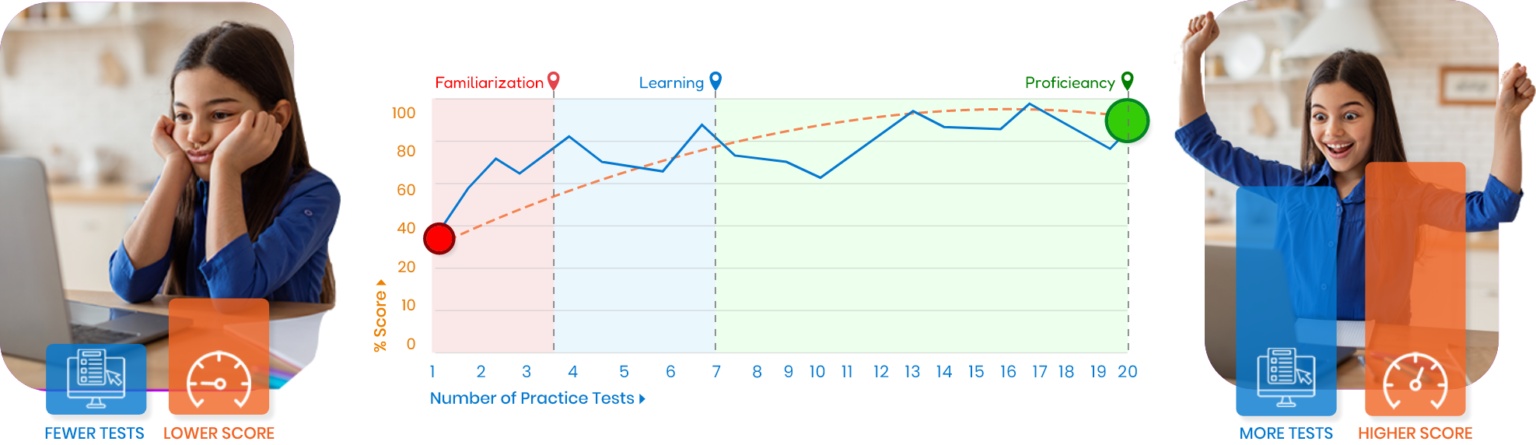

Familiarization
Learning about the types of questions that are asked in the test.

Learning
Knowing how to approach the question and what makes an answer correct.

Proficiency
Improving speed to make sure the test is completed in time.
Start practicing today!
SIGN UPHow AceGiftedTest Can Help
AceGiftedTest helps students become comfortable with the verbal, quantitative, and nonverbal reasoning formats measured by CogAT. Familiarity with question types can reduce uncertainty and allow children to focus on reasoning rather than on understanding unfamiliar directions. Get unlimited full-length practice tests, detailed explanations, video tutorials, AI assistance, and personalized assignments focused on individual weak areas. Practice strengthens broader skills such as pattern recognition, analytical thinking, problem-solving, attention, and pacing. Because NISD evaluates a complete student profile, families should also continue supporting strong reading, mathematics, curiosity, and independent thinking. CogAT preparation can build confidence, but it cannot guarantee GT identification.

Unlimited full-length CogAT practice tests
Generate unlimited full-length CogAT-style practice tests on the fly using AI so your child can build stamina with fresh verbal, quantitative, and nonverbal questions.

Personalized practice assignments
Our AI analyzes your child’s weak spots after each test and automatically creates personalized practice assignments so they can improve where it matters most.

Question-specific tutorial videos
Stuck on a tricky question type? Watch tutorial videos tailored to the exact kind of problem your child is working on—so concepts click faster.

Detailed solutions & AI help, anytime
Every question comes with detailed step-by-step solutions. Lumi, our friendly AI assistant, is always available to guide your child through tough problems without simply giving away the answer.
Quick FAQs
Does Northside ISD use CogAT? Yes. NISD uses CogAT as an ability measure in GT identification and administers it districtwide in Grades 2 and 5.
When is Grade 2 CogAT testing? The official 2026–27 district window is February 1–19, 2027.
Does every Grade 2 student take CogAT? Yes. The NISD testing schedule states that all second graders are tested.
Does a high CogAT score automatically qualify a student? No. NISD reviews CogAT, achievement data, and qualitative evidence as a complete profile.
How can families help a child prepare? Use age-appropriate verbal, quantitative, and nonverbal reasoning practice, review explanations, and keep sessions encouraging and low-pressure. Families should also follow any test-security directions provided by the school.
Who should parents contact? Contact the GT Specialist at the child's campus for referral, testing, and results questions.
Official NISD resources
Last reviewed: 2026-08-05
Help your child prepare for NISD testing
AceGiftedTest offers CogAT-style practice across verbal, quantitative, and nonverbal sections so students build familiarity with question formats before NISD Grade 2 CogAT testing.
Get started with AceGiftedTestCognitive Abilities Test™ (CogAT®) is a registered trademark of Riverside Assessments, LLC. AceGiftedTest and its parent, Lumina Ed, are not affiliated with Riverside Insights, nor is the content on this site promoted or endorsed by Riverside or its affiliates.
AceGiftedTest and its parent company, Lumina Ed, are not affiliated with, endorsed by, or sponsored by Northside Independent School District (NISD). Gifted & Talented identification, CogAT screening, campus-local norms, and related policies are set by NISD and may change each school year. Families should verify details with their child's school and on official NISD websites.