

JCPS Gifted & CogAT — Parent FAQs
Key dates for JCPS families
- Fall 2026: Elementary CogAT administration - JCPS elementary schools administer CogAT during the fall. District materials describe testing for students in Grades 1–5, although the exact schedule and which grades test at a particular school may vary.
- Throughout 2026–27: Review of results and placement decisions - Schools review CogAT results together with classroom performance, achievement data, teacher observations, and other evidence for talent-pool, Advance Program, or gifted-service decisions.
- Before Grade 4 placement: Primary Talent Pool vs. formal identification - Students in the primary grades may be considered for the Primary Talent Pool. Formal gifted identification generally begins for services in Grade 4 and above.
- School-specific dates: Confirm with your school - JCPS has not posted one public districtwide 2026–27 CogAT calendar. Families should confirm the exact testing date and participation details with their child's school.
JCPS public materials confirm fall CogAT administration, but they do not provide a single districtwide 2026–27 testing window. Please check with your child's school or gifted counselor for exact dates and testing information.
Who Takes the CogAT?
JCPS district materials state that students in Grades 1–5 are administered CogAT during the fall.
Some individual elementary schools describe annual CogAT testing for Grades 3–5, so local implementation may differ by school and grade.
Parents should ask the school's gifted-resource teacher or counselor whether their child's grade is testing that year and on what dates.
Primary Talent Pool vs. Formal Gifted Identification
Primary Talent Pool (Grades K–3): Schools use a combination of informal evidence to identify younger students who show high potential and would benefit from enrichment or differentiated instruction. Talent-pool participation is not the same as formal gifted identification.
Formal Gifted Identification (typically Grades 4–5 in elementary school): JCPS uses both formal and informal measures appropriate to the area of giftedness. Students may be identified in intellectual ability, academic aptitude, creativity, leadership, or the visual and performing arts.
For more information, visit the JCPS Family GT & PTP site.
How Does JCPS Use CogAT Results?
JCPS uses a district CogAT score to help distinguish students who qualify for gifted services from students who qualify for the Advance Program. Current district materials describe a score of 24 or higher for gifted qualification and 21–23 for the Advance Program. Because this is a district scoring convention—not a national percentile—families should ask the school to explain the child's score report and the other evidence used in the decision.
A CogAT result alone does not address every gifted category. Creativity, leadership, and arts identification require additional evidence relevant to those areas.
What Services May Identified Students Receive?
- Differentiated or enriched instruction within the regular classroom
- Primary Talent Pool enrichment for high-potential students in the primary grades
- Gifted and Talented services in the student's identified area or areas
- Advance Program coursework or classes for qualifying students
- School-based opportunities such as problem solving, academic teams, robotics, arts, leadership, and other enrichment activities
What Does the CogAT Measure?
The CogAT measures how students reason and solve unfamiliar problems in three areas:
- Verbal reasoning: word relationships, analogies, sentence completion, and classification
- Quantitative reasoning: number relationships, patterns, and mathematical problem-solving
- Nonverbal reasoning: figure matrices, classifications, paper folding, and spatial thinking
CogAT Testing Format
The CogAT assesses your child's cognitive development in three key areas: verbal, quantitative, and non-verbal abilities. Rather than focusing on academic knowledge, it evaluates reasoning skills that your child uses to solve problems and think critically.
Note: There are some variances in the testing format for students in grades 3 and up. If your child is in grades 3–5, click on the Level 3–5 tab below to learn more about the test format for those grades.
This section assesses your child's ability to understand and use language. It includes the following three sections:
Picture Analogies
Picture Classification
Sentence Completion
Which CogAT level should my child prepare for?
The CogAT level for each grade is determined by the school district. Based on recommendations from Riverside Insights, the following table shows typical CogAT levels for JCPS elementary grades involved in fall screening:
| Grade | CogAT Level |
|---|---|
| Grade I | Level 7 |
| Grade II | Level 8 |
| Grade III | Level 9 |
| Grade IV | Level 10 |
| Grade V | Level 11 |
Please confirm the correct CogAT level for your child with JCPS or your child's school before beginning preparation.
How to Prepare for JCPS CogAT Testing
Help your child prepare for the CogAT by building broad reasoning skills rather than memorizing a single question type.
- Practice all three CogAT batteries—verbal, quantitative, and nonverbal—rather than memorizing answers.
- Use age-appropriate analogies, classifications, number patterns, matrices, and spatial puzzles.
- Review mistakes so your child learns the reasoning behind each answer.
- Use occasional timed practice to build focus and pacing without creating unnecessary pressure.
- Continue building classroom reading and mathematics skills because JCPS also considers academic and classroom evidence.
Practicing daily or every other day makes test-taking second nature to your child
More
Tests

Fewer
Mistakes

More
Confidence
Higher
Test Score
Test Preparation Journey
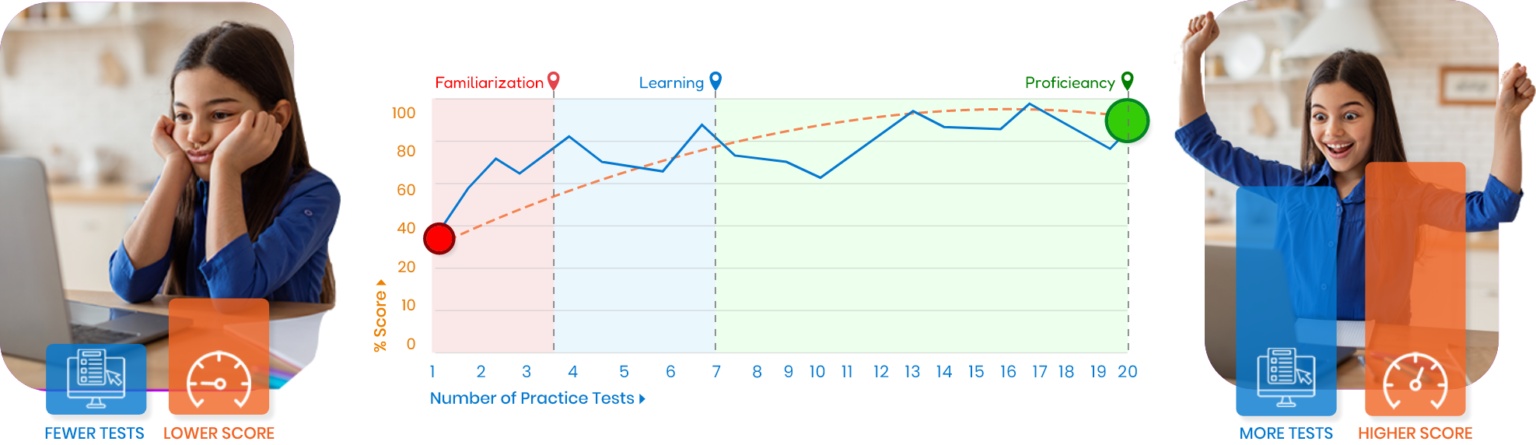

Familiarization
Learning about the types of questions that are asked in the test.

Learning
Knowing how to approach the question and what makes an answer correct.

Proficiency
Improving speed to make sure the test is completed in time.
Start practicing today!
SIGN UPWhy AceGiftedTest?
AceGiftedTest helps children become familiar with the verbal, quantitative, and nonverbal reasoning tasks measured by CogAT. Students receive unlimited full-length tests, detailed explanations, video tutorials, AI assistance, and personalized practice focused on individual weak areas.

Unlimited full-length CogAT practice tests
Generate unlimited full-length CogAT-style practice tests on the fly using AI so your child can build stamina with fresh verbal, quantitative, and nonverbal questions.

Personalized practice assignments
Our AI analyzes your child’s weak spots after each test and automatically creates personalized practice assignments so they can improve where it matters most.

Question-specific tutorial videos
Stuck on a tricky question type? Watch tutorial videos tailored to the exact kind of problem your child is working on—so concepts click faster.

Detailed solutions & AI help, anytime
Every question comes with detailed step-by-step solutions. Lumi, our friendly AI assistant, is always available to guide your child through tough problems without simply giving away the answer.
Quick FAQs
Does JCPS use CogAT? Yes. JCPS administers CogAT during the fall and uses the results as part of gifted and Advance Program decisions.
What grades are tested? Students across Grades 1–5 are tested.
When exactly will my child test? The district has not posted one public 2026–27 CogAT calendar. Ask your child's school for its testing schedule.
Is the Primary Talent Pool formal gifted identification? No. It is an early talent-development pathway for high-potential students in Grades K–3.
Does one CogAT score determine everything? No. Schools also use academic performance, observations, and category-specific evidence.
What is the Advance Program? It is an advanced instructional option for students who meet JCPS criteria, including the district CogAT range for that program.
Official JCPS resources
Last reviewed: 2026-08-01
Help your child prepare for JCPS testing
AceGiftedTest offers CogAT-style practice across verbal, quantitative, and nonverbal sections so students build familiarity with question formats before JCPS gifted testing.
Get started with AceGiftedTestCognitive Abilities Test™ (CogAT®) is a registered trademark of Riverside Assessments, LLC. AceGiftedTest and its parent, Lumina Ed, are not affiliated with Riverside Insights, nor is the content on this site promoted or endorsed by Riverside or its affiliates.
AceGiftedTest and its parent company, Lumina Ed, are not affiliated with, endorsed by, or sponsored by Jefferson County Public Schools (JCPS). Gifted identification, Primary Talent Pool, Advance Program placement, CogAT screening, and related policies are set by JCPS and may change each school year. Families should verify details with their child's school and on official JCPS websites.